Technical Guide

What is a Bearing?

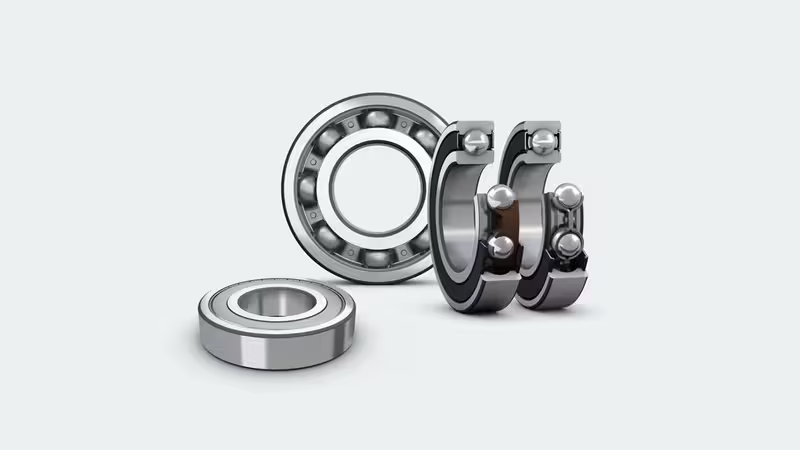
Bearings are mechanical elements used to reduce friction between rotating machine components and carry loads.

Bearing Dimensions
Basic Function

Why Bearings?

A good bearing directly increases the reliability of a mechanism. From reducers, fans and pumps to machine tool spindles; automotive shafts, axles, gearboxes, belt tensioning systems, alternators and steering systems; water pumps and doors to industrial electric motors, washing machines and electric vacuums, agricultural and heavy machinery, wind turbines - bearings are used in virtually every rotating application.

KRV Metal provides reliable products for this wide range of applications, backed by 100% testing on deep groove ball bearings.

Rulman ve uygulama alanları 100% Test
Structure

Bearing Components

Main parts and functions that make up a bearing

Retainers/Cages

Holds rolling elements at equal intervals, prevents them from rubbing against each other during rotation. Does not carry load.

  • Steel sheet cage (J): DC04/01/03, up to 150°C, riveted in two halves.
  • Plastic TN: P6.6 (A4H), 115°C.
  • Plastic TN1: P6.6 (A3HG5), 150°C.
  • Plastic TH1: P4.6 (Stanyl), 170°C.
  • Solid brass (M): Heavy loads and vibration; costly.

Stamped from steel/brass sheet, solid machining, or plastic injection molding. Polyamide 6.6/4.6-based plastic cages are preferred in many applications for their lightness and low noise.

Seals/Shields

Prevents grease from leaking out and foreign matter from entering.

  • Sheet seal (Z): TS 275 / DIN EN 10202; suitable for high speeds.
  • Rubber seal (RS): NBR, ACM, FKM, NDNN, HNBR; better sealing, speed limited (can be improved with RSR, RS1, RDD, etc.).

Temperature ranges: NBR -30/+105°C, NDNN -40/+130°C, HNBR -40/+150°C, ACM -20/+150°C, FKM -30/+200°C (higher values possible for short periods).

Rolling Elements

Provides load transmission; determining factor in bearing classification.

Balls: Spherical; low friction, suitable for high speeds. Steel or ceramic. Point contact.

Rollers: Tapered, cylindrical, spherical, needle. Line contact, higher load capacity; load distribution improved with surface crown.

Maintenance

Lubrication and Grease

Proper lubrication is critical to prevent metal-to-metal contact and wear between rolling elements and raceways.

Grease

Mineral or synthetic oil thickened with additives. Most common bearing lubrication; used in ~90% of applications. Proper selection for load, temperature, speed and environment is required. 20-30% of inner cavity fill is the general rule; reduced at high speeds. Grease applied during manufacture is lifetime sufficient for most applications.

Liquid Oil

Preferred at high speeds or temperatures where grease is unsuitable; for low friction, cooling, noise and vibration reduction needs. Oil bath, splash, drip, circulation, mist or air-oil mixture, spray lubrication methods are applied.

Logistics

Packaging Materials

Packaging is designed to protect against rust; preservation oil or VCI is important. Single box, single polyethylene bag, bulk or custom design; materials vary according to customer requirements and shipping conditions. KRV Metal offers standard or custom packaging options.

Complementary

Accessories

Press sleeves, plastic sleeves, nuts, felt, sheet covers, press springs, etc. are used according to application or design requirements. Bearings can be supplied as a set with these accessories.

Bearing Dimensions and Products

Explore our deep groove ball bearing catalog — reliable products backed by 100% testing.

Go to Bearing Dimensions